app.virtconsole.com/vpcs
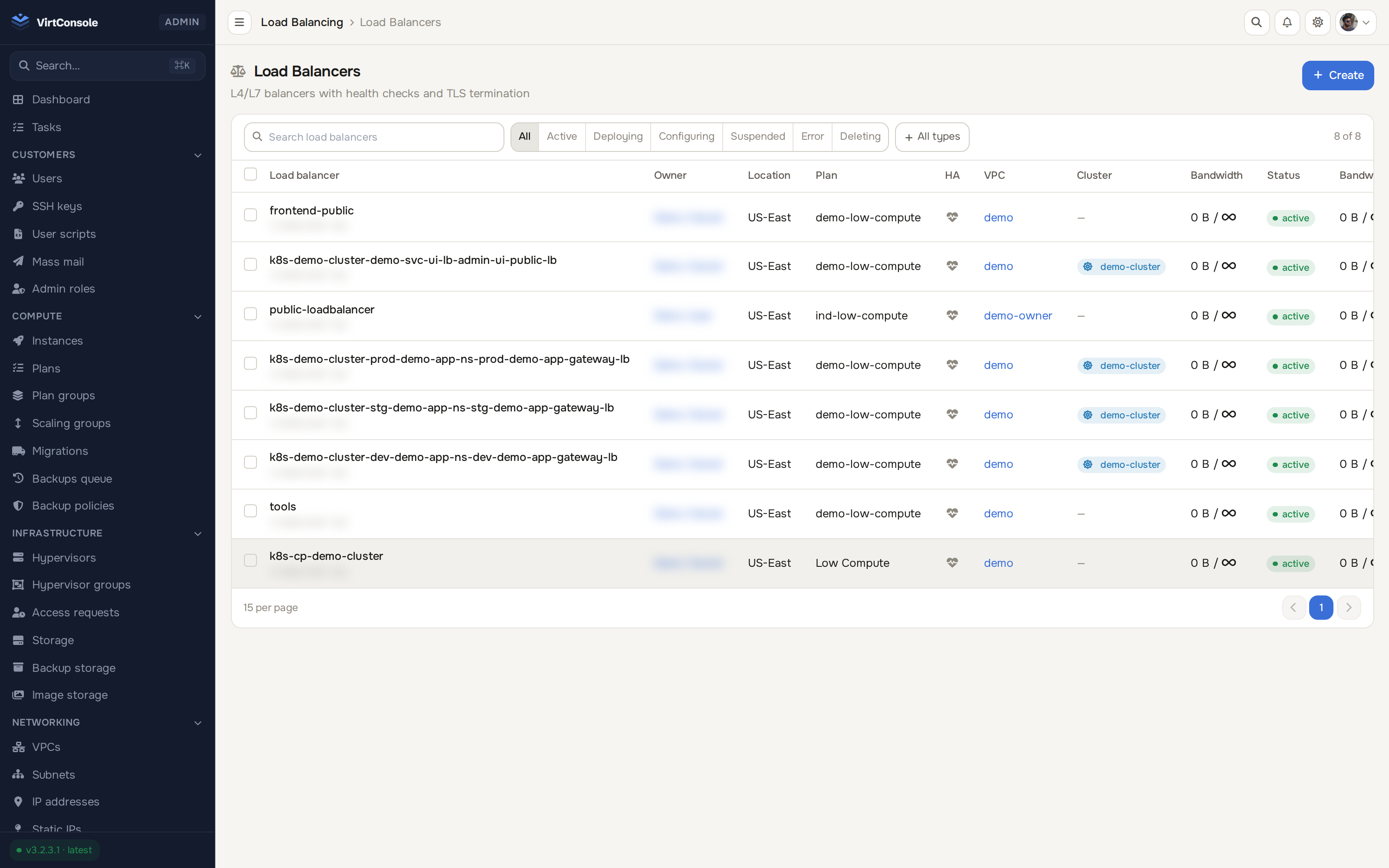
Isolated VPCs, managed load balancers, account-owned certificates and firewalls that enforce down to the hypervisor. Every public resource gets a real hostname automatically.
Isolated private networks that span hypervisors, with redundant gateways.
Multicast or unicast mode per hypervisor group, so VPCs work in datacenters where multicast is unavailable.
Managed NAT with per-GB bandwidth billing, configurable accounting and automatic overage enforcement. Keepalived redundancy across nodes.
Full dual-stack subnet management, with per-interface speed controls set per group and overridable per plan.
Site-to-site tunnels and road-warrior clients that receive the VPC’s private DNS resolver automatically.
VPC search domains ship with the link, and the gateway resolver always runs, so private names resolve on first lookup.
VPC NICs attach and detach on running instances, on KVM and Proxmox alike.
HAProxy under the platform’s control, hardened by three years of production fixes.
TLS at the edge, active health checks with a configurable Host header, session stickiness and connection draining.
Rules match on request host as well as path, so one load balancer serves several hostnames to different backends.
Deploy onto allocated static IPs so the address can be firewalled and DNS’d before the LB exists. Per-frontend idle timeouts keep SSH and database sessions alive.
A stranded load balancer recovers on its own, stale callbacks can never overwrite newer state, and one bad certificate never blocks a listener.
TLS certificates as account-owned objects, like AWS ACM.
Upload a certificate or issue one from Let’s Encrypt once, then reuse it across every listener that needs it.
A listener holds an ordered set of certificates, one default plus any number served by SNI. Two domains share one IP.
Uploads verify key match and CA chain, expired material is rejected, and expiry alerts page you before a certificate lapses.
Layered enforcement from the panel down to the hypervisor.
Inbound and outbound rules applied in real time, with IP sets for reusable address lists.
Explicit drop rules override broader accepts, consistently on KVM and Proxmox.
IP filters pin each NIC to its assigned addresses, so a guest cannot impersonate its neighbors.
Provisioning produces real hostnames, not bare IPs.
Every public instance, database, load balancer and control plane gets a hostname at provision time, with matching PTR records where the reverse zone allows.
Base domains onboard through a four-step wizard with real verification: a random record is written and confirmed through public resolvers before anything publishes.
A Let’s Encrypt wildcard per base domain lets customers connect with verify-full against the public trust store.
PowerDNS, ClouDNS and Cloudflare wired into the panel, plus a self-contained PowerDNS deployment kit for authoritative DNS fleets.
A single load balancer's frontends and health checks, next to the domains System DNS manages behind every public resource.
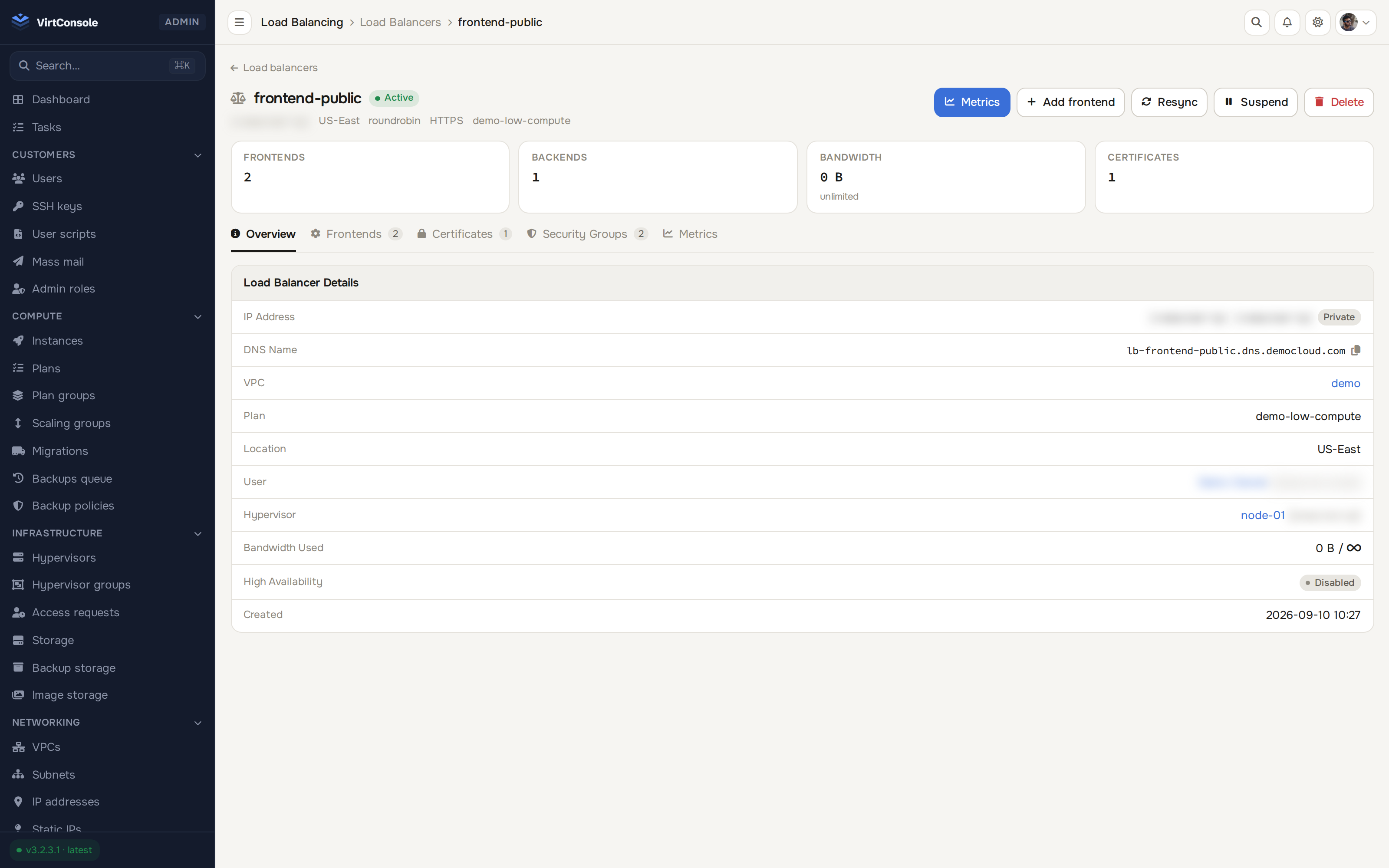
A load balancer open: frontends, backend pool, health checks
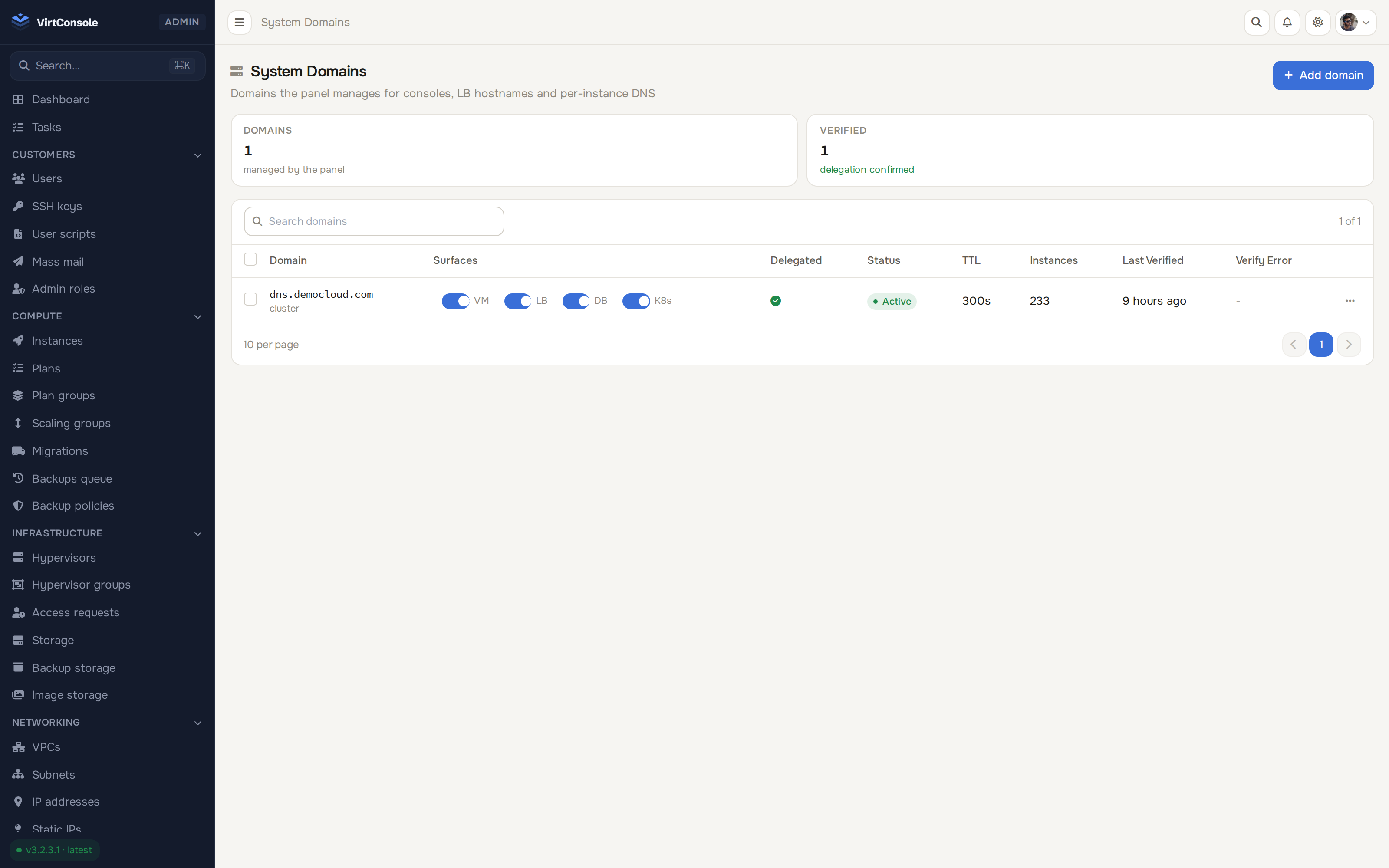
System DNS: the domains behind every public hostname
Free 30-day trial. Every feature included. No credit card required.
30 days, every feature, no credit card, VirtConsole installs with the trial active by default. Just run the installer on your own hardware.
Debian 11/12/13 · Ubuntu 22.04/24.04/26.04 · Rocky / Alma / CentOS Stream 9/10 · run as root.