app.virtconsole.com/hypervisors/proxmox
One member IP and one API token link a standalone node or a whole cluster. Agentless over the Proxmox REST API, so VMs stay visible in the PVE web UI and nothing on the node is patched.
Give the panel one member IP and one API token. It discovers and links every node in the cluster.
The driver talks to the Proxmox REST API and nothing else. VMs stay visible in the PVE web UI, tasks are ordinary PVE tasks, nothing on the node is patched.
SDN and FRR prerequisites, storage discovery and token privileges are all checked when a node links, not at first deploy.
Standalone nodes and clusters, running side by side with KVM groups on one panel with the same plans and billing.
Plain QEMU VMs, no template storms, and clean adoption of what already exists.
Deploy, power, suspend, reinstall, resize, destroy, ISO mounting, cloud-init, GPU passthrough, VM tags and per-tenant resource pools.
OS images build into a vzdump archive once, then every deploy restores it into the customer’s VM ID. No template VMs parked on your nodes.
Adopt any VM the panel did not create, including raw, ZFS, LVM and Ceph-backed disks, and attach it to a user as a managed instance.
VPCs realized as EVPN zones, security groups compiled to the PVE firewall.
An EVPN zone per VPC with dedicated VRF VNI, vnets and subnets per VPC subnet, and NAT gateways with cluster-wide SNAT semantics.
Accept and drop rules, IP sets, anti-spoofing filters and per-VM rulesets, reconciled by fingerprint with a cron backstop.
Addresses read live from the QEMU guest agent, filtered of loopback and link-local noise.
All common PVE backends, detected with their real capabilities.
Directory, NFS, LVM, LVM-thin, ZFS and Ceph RBD, including onboarding an external Ceph cluster directly from the panel.
Backup, restore and delete per instance with optional live-restore, plus native scheduled jobs with full retention control.
With Proxmox Backup Server, browse a backup’s filesystem and download individual files. VM snapshots with optional RAM state and rollback.
The same PBS destination backs up your KVM hypervisors too, from one panel under one set of policies. Deduplicated, verified at rest, and kept after the instance is destroyed unless you choose to delete it.
Live migration, HA through the layer that actually owns fencing, and honest billing.
Move a running VM between cluster nodes with an eligibility precheck, local-disk handling, bandwidth limits and a dedicated migration network option.
Instances enroll into Proxmox’s own HA stack on deploy. The panel mirrors CRM state instead of running a second watchdog.
Counters read from the host split VPC from public traffic, so nothing is double-billed, with reset-safe accumulation across reboots.
Operational failures surface as structured admin issues with retry actions, instead of hiding in a log file.
noVNC, serial and WebSSH. VPC-only guests are reached through a small host-side proxy that installs with one command on one node.
Docker, managed databases, load balancers, Kubernetes, SSH keys and password resets all work over the QEMU guest agent.
Linked nodes and clusters from both drivers, with status, storage and VM counts in a single list.
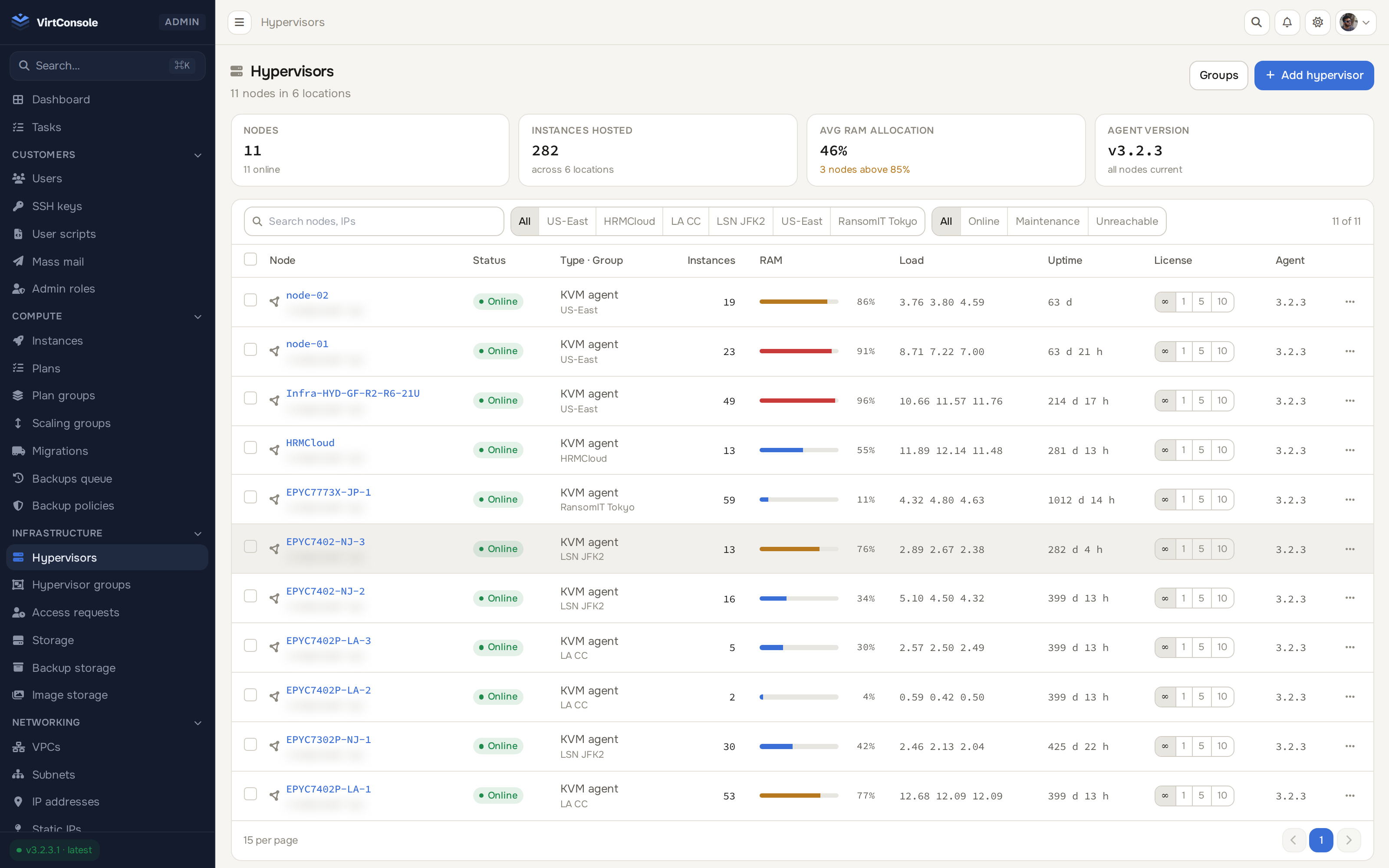
Every linked node, KVM and Proxmox side by side
Free 30-day trial. Every feature included. No credit card required.
30 days, every feature, no credit card, VirtConsole installs with the trial active by default. Just run the installer on your own hardware.
Debian 11/12/13 · Ubuntu 22.04/24.04/26.04 · Rocky / Alma / CentOS Stream 9/10 · run as root.